A Few Words on VistaVision
Screen card usually shown before a VistaVision production begins.
With the Christmas holidays having just passed and watching White Christmas from 1954 for the first time and learning that it was the first film to be shot using Paramount’s new VistaVision process, I couldn’t help but feel a bit defeated. The format is a rare commodity nowadays. And we should all be demanding answers as to why.
This year’s One Battle After Another from Paul Thomas Anderson was also shot in VistaVision. In an interview conducted with Konbini, Anderson shares a little bit of his experience and knowledge of working in VistaVision.
One Battle was screened in VistaVision, large screen format [only in major cities like New York, Los Angeles, Boston]. What does this mean? Well, only that he had to scramble to get ahold of older, refurbished projectors to even be able to screen the movie in VistaVision.
According to Anderson, the VistaVision camera is more compact than the IMAX camera and not as loud. It could blow up gigantic to IMAX size and also fits other formats so it’s very versatile.
This is very important to know since most filmmakers today do not shoot their films in VistaVision. They simply don’t have the resources as studios are very reluctant to invest in the format. Anderson, a filmmaking veteran, has earned his stripes and liberty to do so. VistaVision filmmaking is by no means the standard.
The Brutalist (2024) was shot in VistaVision, but was not distributed in the format, although I did see a 70mm film print of in New York City. In fact, its cinematographer, Lol Crawley, won the Oscar for Best Cinematography. But going forward, this won’t be the norm and rather is the exception.
I say all of this to say, the majority of people today have no idea that this wonderful, adaptable format even existed and meagerly exists today. Heck, I didn’t even know there were such things as VistaVision projectors. Really, the only thing I knew about VistaVision was that one of the greatest films ever made, Vertigo (1958), was shot in VistaVision. The Searchers (1956) as well.
In the same interview, Anderson mentions Paris, France does not even have a VistaVision projector!
We’re being cheated and we don’t even know it.
A brief history of VistaVision; it was developed by a Paramount engineer. It’s a high-resolution 35mm film format that was made to be projected by any projector and would look the same in theaters nationwide without requiring the change of the shape of the theater as did Cinemascope and Cinerama.
The VistaVision process is quite unique. Normally, a piece of film runs vertically through the camera. But with VistaVision, it runs horizontally through the camera. This produces the effect of making the film image clearer, sharper, and more vivid- truer to real life.
Where has it gone? A quick Google search tells me that Yorgos Lanthimos’s Bugonia (2025) was also shot in VistaVision and Greta Gerwig’s upcoming Narnia film will be as well.
According to IMDB, only a hundred or so films have been shot in VistaVision.
Why isn’t this the standard?
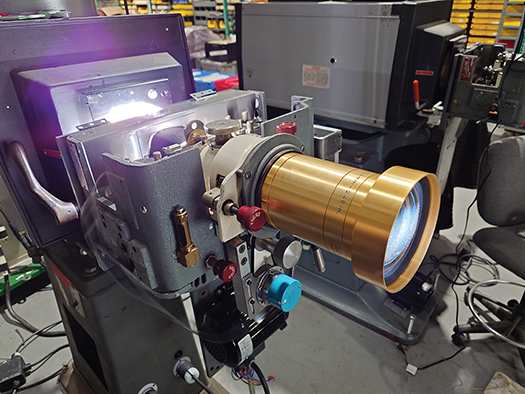
A specially crafted projector used to project the VistaVision films “We’re No Angels” and “Gunfight at the O.K. Corral” at TCM Film Festival, April 2025.
I could only point to corporate greed and technological “advancements.” Is it really advancing if you’re losing something- everything once crucial to an art form? Is it truly advancing if you’re sacrificing history and quality in the pursuit of a buck? Is it “better” because it’s cheaper?
And who can we hold accountable for this-for the lack of film projectors that can project VistaVision-shot films? The irresponsible and shameless movie studios? Studio heads who had and have no interest in film presentation, and even less, sadly, in film preservation?
I am reminded of an interview I heard with film critic, Dave Kehr, and he lamented how some of the most interesting films of the silent era (1915-1920), we will most likely never see because 90% of them are gone. I can’t even begin to imagine what we’ve lost.
Images and lessons we will never see and learn. Concepts and ideas that could have inspired us. It is tragic and deflating.
Film presentation and preservation matters. I refuse to live in a world where movies don’t matter- a world where film history, its proper maintenance, and final delivery to a captive audience, the silver screen, don’t matter.
Technological advancements aren’t always positive. We got rid of VistaVision projectors to replace them with USB flash drives and digital files.
Because we’re “advancing,” we’re supposed to completely discard the “old” and leave it behind? VistaVision was and still is pivotal to cinema.
One of my issues with tech advancements is the false notion that they have a human element in them that is supposed to make us feel more comfortable using them. It’s a sneaky trick to get us to go along with it. An example is asking ChatGPT something and waiting for its output, you usually notice it says it’s “Thinking…”
Well, no it’s not. It’s really processing. It’s a computer. But this comes with the bill of false goods that we’ve been sold.
And don’t even get me started on the streaming services’ lack of interest in the cinema and film culture- it makes my blood boil.
Own. Physical. Media.
VistaVision filmmaking and projection is rare. It’s six feet in the grave and our moviegoing experience isn’t better for it. Couple that with the high cost of movie ticket prices and you have an industry on the brink of collapse because the audience has had enough and is waking up to its apathetic, greedy nature.
As I write this, Netflix has been trying to buy Warner Brothers and we’re just supposed to be okay with that? I can guarantee you with absolute certainty that Netflix does not know the history of the legendary studio and has absolutely no interest in preserving it.
What I am getting at is that entertainment companies and movie studios have a real, dare I say, sacred responsibility to the current viewers, but also to future generations.
This responsibility should not be only to deliver a great, entertaining product while making a profit, but also to deliver it in the best format possible that many generations can and will benefit from.
This responsibility should be their badge of honor. Because like I always say, if everything is about a dollar, then nothing has value.